
Yiddish Names for Boys

By Nameberry
Updated Tue Jun 09 2020
Share
Copy link
Yiddish names for boys originate in the language spoken by Ashkenazic Jews and brought to the US a century or more ago. Today, many Jewish parents are reviving beloved Yiddish baby names, along with the Yiddish language.
If you're looking for a Yiddish name for your son, browse our full list of Yiddish names for baby boys here. The top names below rank among the current US Top 1000 Baby Names and are ordered by popularity. Unique names rank below the Top 1000 and are listed alphabetically.
If you're looking for a Yiddish name for your son, browse our full list of Yiddish names for baby boys here. The top names below rank among the current US Top 1000 Baby Names and are ordered by popularity. Unique names rank below the Top 1000 and are listed alphabetically.
- Tevel
Origin:
Hebrew, YiddishMeaning:
"world, universe"Description:
Derived from the Hebrew word for "universe, macrocosm, world", this modern choice may appeal to those who like Evren for its meaning.
- Liev
Origin:
Yiddish variation of LevMeaning:
"heart"Description:
Liev Schreiber's birth name is Isaac Liev, Liev after his mother's favorite Russia author, Leo Tolstoy. Though Liev is increasing in popularity in the secular world thanks to the actor, it originated as a Yiddish diminutive.
- Feivel
Origin:
YiddishMeaning:
"brilliant one"Description:
This comes from Faivish, the Yiddish form of Phoebus, the Greek sun god...and it's also the little mouse in "An American Tail."
- Moshe
Origin:
HebrewMeaning:
"son or deliver"Description:
Moshe is the original Hebrew form of Moses, also spelled Mosheh. In the past it was changed to names like Morris, Moe and Maurice.
- Shem
Origin:
HebrewMeaning:
"name"Description:
This down-to-earth Bible name is surprisingly little-used, considering the popularity of other Old Testament names. Shem was Noah's eldest son, and is the origin of the term Semitic (as in the language family).
- Yeshua
Origin:
Variation of Joshua, HebrewMeaning:
"the Lord is my salvation"Description:
Yeshua is often considered the "real" name of Jesus, via the Hebrew to Greek to Latin to English evolution of Yeshua to Iesous to Iesus to Jesus. It is also used as a common alternative of Yehoshua in the later parts of the Hebrew Bible, making it a variation of Joshuah.
- Brick
Origin:
Word name, various originsDescription:
This is an Anglicized form of various names; the Irish Gaelic O Bruic; German, Bruck or Breck, meaning "swamp" or "wood"; Yiddish, Brik, "bridge"; and Slovenian, Bric, "dweller from a hilly place." Gosh, and we thought it was just a macho word name invented by Tennessee Williams for the hero of Cat on a Hot Tin Roof.
- Adi
Description:
Adi is a multicultural masculine name with diverse origins and meanings across several traditions. In Hebrew, it means 'jewel' or 'ornament,' while in Sanskrit it can mean 'first' or 'beginning.' The name also has Germanic roots where it serves as a short form of names containing the element 'adal' meaning 'noble.' This concise, two-syllable name has gained popularity in Israel, India, and increasingly in Western countries drawn to its simplicity and international appeal. Adi travels well across cultures and is appreciated for its modern feel despite ancient origins. Its brevity makes it both memorable and easy to pronounce in multiple languages, contributing to its growing global usage.
- Anshel
Description:
Anshel is a masculine name of Yiddish origin, primarily used in Jewish communities. It's believed to be derived from the Hebrew name Asher, meaning 'happy' or 'blessed,' or possibly from the German name Anselm, which combines elements meaning 'god' and 'helmet' or 'protection.' Anshel was common among Eastern European Jewish communities before World War II but became less frequent afterward. The name carries deep cultural significance in Jewish heritage and history. While relatively uncommon globally, Anshel has seen some renewed interest among families seeking to honor Jewish ancestry and traditions. It offers a distinctive choice with meaningful cultural connections and historical depth.
- Evron
Description:
Evron is a masculine name with Hebrew origins, possibly derived from 'evron' meaning 'crossing' or as a variation of Ephron, a biblical name meaning 'dust' or 'fawn-like'. This uncommon name has a modern, distinctive sound while maintaining ancient roots. Evron may also relate to geographical locations, including a region in Israel. The name has never been widely popular in English-speaking countries, remaining a rare choice that offers uniqueness without being completely unfamiliar in structure. Its balanced combination of consonants and vowels gives it a pleasant rhythm. Parents might choose Evron seeking a name with biblical connections but a contemporary feel and relative uniqueness.
- Shmulke
Description:
Shmulke is a masculine name with Yiddish origins, functioning as a diminutive form of Shmuel (the Hebrew equivalent of Samuel). The suffix '-ke' adds an affectionate or endearing quality, similar to adding '-y' or '-ie' in English. Common in Eastern European Jewish communities during the 19th and early 20th centuries, Shmulke conveys warmth and familiarity within traditional Ashkenazi culture. The name declined in usage following World War II and subsequent assimilation of Jewish communities into mainstream society. Today, Shmulke is rarely given as a formal name but might be used as a nickname in Yiddish-speaking families or communities preserving traditional naming patterns.
- Yankel
Description:
Yankel is a masculine name with Yiddish origins, traditionally used as an affectionate form of Jacob (Yaakov in Hebrew). Popular among Ashkenazi Jewish communities in Eastern Europe, Yankel carries warm, familial associations within Jewish cultural contexts. The name traveled with Jewish immigrants to America and other countries, though it has typically been replaced by more mainstream versions like Jacob or Jack in subsequent generations. Yankel evokes a sense of old-world charm and connection to Jewish heritage. While less common today as a formal given name, it continues to appear in Jewish literature, folklore, and as a nickname. The name resonates with cultural significance, often representing traditional Jewish values and community ties.
- Mende
Description:
Mende is a masculine name with multiple possible origins. In some West African cultures, particularly among the Mende people of Sierra Leone, it serves as both an ethnic identifier and personal name. Alternatively, it may derive from Germanic elements, possibly related to 'mund' meaning 'protection.' As a given name, Mende remains quite rare globally, making it a distinctive choice that carries cultural significance for those with African heritage or connections. The name's simplicity—just two syllables with a clear pronunciation—gives it an accessible quality despite its uncommon status. For parents seeking a name with cultural depth or international character, Mende offers a meaningful option that's brief yet substantial. Its rarity means most bearers of the name will define it through their own personality rather than existing associations.
- Yossel
Description:
Yossel is a masculine name of Yiddish origin, serving as a diminutive form of Yosef (Joseph). The name Joseph comes from Hebrew, meaning 'God will add' or 'God will increase.' Yossel was particularly common among Ashkenazi Jewish communities in Eastern Europe before the mid-20th century. The diminutive suffix '-el' adds an affectionate quality to the traditional name. Following the Holocaust and subsequent migration of Jewish populations, traditional Yiddish names became less common, though they remain important cultural identifiers. Today, Yossel is relatively rare, primarily used in traditional Jewish communities preserving Yiddish naming customs. The name carries deep cultural significance, connecting bearers to Jewish heritage and history. For many families, using names like Yossel represents an intentional preservation of cultural traditions that might otherwise be lost.
- Moishe
Origin:
Yiddish variation of Moses, EgyptianMeaning:
"delivered from the water"Description:
A name commonly heard on New York's Lower East Side at the turn of the last century.
- Moyshe
Description:
Moyshe is a masculine name representing the Yiddish form of Moses, a name of ancient Egyptian and Hebrew origins. In Jewish tradition, Moses (Moshe in Hebrew) was the prophet who led the Israelites out of slavery in Egypt and received the Torah at Mount Sinai. The Yiddish pronunciation and spelling reflects the language developed by Ashkenazi Jewish communities in Central and Eastern Europe. Moyshe carries deep cultural and religious significance in Jewish communities, particularly those with connections to Yiddish-speaking regions. While less common today than in previous generations, the name continues to be used in traditional Jewish families honoring linguistic heritage. The name conveys wisdom, leadership, and commitment to faith and community values.
- Schmuel
Description:
Schmuel is the Yiddish variant of the Hebrew name Samuel (שְׁמוּאֵל/Shmuel). It carries the same meaning as its Hebrew counterpart: 'name of God' or 'God has heard.' This name has deep significance in Jewish communities, particularly among Ashkenazi Jews of Eastern European descent. Pronounced 'shMOO-el,' it reflects the distinctive phonetics of Yiddish language adaptations of biblical names. Schmuel appears in numerous Yiddish literary works and has been carried by notable Jewish scholars and rabbis throughout history. While less common than Samuel in contemporary usage, it remains a meaningful choice for families honoring their Jewish heritage or Yiddish-speaking ancestors.
- Shlomo
Origin:
HebrewMeaning:
"his peace"Description:
Rarely, if ever, heard outside the Jewish community.
- Teive
Description:
Teive is an uncommon masculine name with obscure origins, possibly deriving from Portuguese or Sephardic Jewish heritage. It may be related to the surname Teive found in Portuguese-speaking regions or could be a variation of Steve or Stephen. The name has a distinctive brevity and modern sound despite potential historical roots. Teive combines uniqueness with straightforward pronunciation, making it accessible despite its rarity. With just two syllables and a balanced blend of consonants and vowels, Teive offers simplicity while remaining distinctive. The name carries a contemporary feel with potential ancient connections, appealing to parents seeking an uncommon name that still sounds familiar enough to be easily pronounced.
- Issur
Description:
Issur is a masculine name with Hebrew and Yiddish origins. It may have developed as a variation of the Hebrew name Isser or Issar, which is believed to be related to the Hebrew word 'asur' meaning 'bound' or 'forbidden.' The name gained some recognition as the birth name of actor Kirk Douglas, who was born Issur Danielovitch before adopting his stage name. In Jewish communities, particularly among Ashkenazi Jews, the name has historical usage though it remains relatively uncommon in mainstream society. Issur has a strong, distinctive sound with its double 's' and concise ending. The name carries a sense of heritage and cultural connection for those with Jewish ancestry, while offering a rare and distinctive option for parents seeking a name with historical depth.
The Nameberry App Is Live
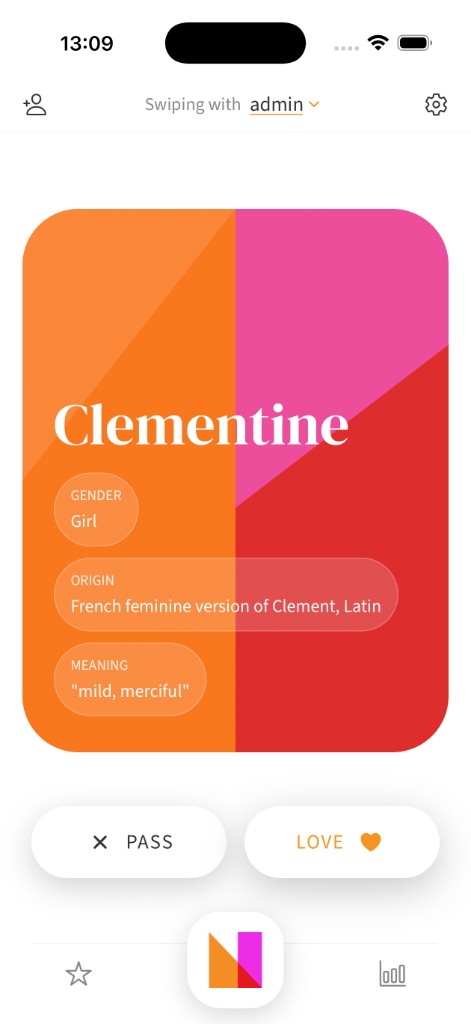
Find your perfect baby name together in our iPhone app, now available on the App Store.
- Swipe through thousands of names with your partner
- Names you match on are saved to your shared list
- Get personalized recommendations that learn based on your and your partner's preferences
- Partner with friends and family to find names you all love
- Backed by Nameberry's 20 years of data around name preferences.